

Hey there! As a supplier of Disc Ploughs, I'm super stoked to share with you all about how these bad boys work. You know, a disc plough is a pretty essential piece of equipment in the agricultural world. It's used to break up, turn over, and aerate the soil before planting. So, let's dig into the working principle of a disc plough.
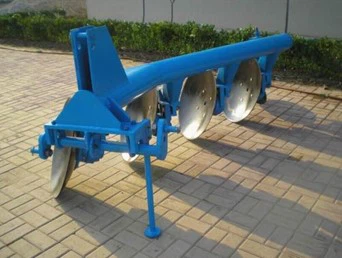
First off, let's talk about what a disc plough actually is. A Disc Plough consists of a series of concave discs that are arranged in a row. These discs are mounted on a frame, and they're designed to cut through the soil. The discs are usually made of high - carbon steel or other durable materials to withstand the tough conditions in the field.
When it comes to the working principle, it all starts with the tractor. The disc plough is attached to the tractor using a three - point hitch system. This allows the plough to be easily lifted, lowered, and adjusted according to the requirements of the field. The tractor provides the power needed to pull the disc plough through the soil.
As the tractor moves forward, the discs start to rotate. The rotation of the discs is a key part of the working principle. The concave shape of the discs causes them to cut into the soil at an angle. When the disc rotates, it creates a shearing force that breaks up the soil clods. This shearing action is much more effective than a simple pushing or pulling motion.
The angle at which the discs are set is crucial. There are two main angles to consider: the disc angle and the tilt angle. The disc angle is the angle between the plane of the disc and the direction of travel. A larger disc angle means that the disc will cut deeper into the soil and turn it over more effectively. The tilt angle, on the other hand, is the angle between the vertical axis of the disc and the vertical plane. This angle affects how the soil is lifted and turned over.
Let's take a closer look at how the discs interact with the soil. When the disc first enters the soil, it cuts through the top layer. As it rotates, the soil is lifted up along the concave surface of the disc. The soil then slides up and over the edge of the disc, causing it to be turned over. This process not only breaks up the soil but also buries any crop residues, weeds, or fertilizers that are on the surface.
One of the advantages of a disc plough is its ability to work in tough soil conditions. For example, in heavy clay soils, a Share Plow might get stuck or have difficulty breaking up the soil. But a disc plough can cut through the clay with relative ease because of its rotating discs. The discs can also work in rocky or root - filled soils without getting damaged as easily as some other types of ploughs.
Now, let's talk about the Driven Disc Plough. Unlike a regular disc plough that is pulled by the tractor, a driven disc plough has its own power source for the rotation of the discs. This additional power can make the plough even more efficient, especially in very hard or compacted soils. The driven discs can rotate at a higher speed, which increases the shearing force and allows for better soil penetration.
In a driven disc plough, the power is usually transferred from the tractor's power take - off (PTO) to the disc drive mechanism. This mechanism can be a gearbox, a chain drive, or a hydraulic system. The choice of drive mechanism depends on the design and the intended use of the plough.
Another important aspect of the working principle is the adjustment of the plough. You can adjust the depth of the plough by changing the position of the three - point hitch on the tractor. A deeper ploughing depth is useful for breaking up hardpan layers in the soil, while a shallower depth is suitable for lighter tillage operations. You can also adjust the spacing between the discs. A wider spacing is good for rough ploughing, while a narrower spacing is better for more precise tillage.
Maintenance is also an important part of keeping a disc plough working properly. Regularly checking the discs for wear and tear is essential. If the discs are worn, they won't cut through the soil as effectively. You should also lubricate the bearings and other moving parts to ensure smooth operation. And of course, cleaning the plough after each use helps to prevent rust and corrosion.
So, there you have it - the working principle of a disc plough. Whether you're a small - scale farmer or a large - scale agricultural operation, a disc plough can be a great addition to your equipment fleet. It offers efficient soil tillage, can work in a variety of soil conditions, and can be adjusted to meet your specific needs.
If you're interested in purchasing a disc plough or have any questions about our products, we'd love to hear from you. Just reach out to us, and we'll be happy to discuss your requirements and help you find the perfect plough for your farm.

References
- Agricultural Machinery and Equipment Handbook
- Principles of Agricultural Engineering


